





 About Us
 2026-03-25
Today, steel structures have become the preferred structural form for large-scale buildings such as industrial plants, convention centers, and sports venues, thanks to their high strength, recyclability, and short construction cycles. Efficient installation processes and rigorous safety protocols are essential to ensuring project quality meets standards and on-time delivery, directly impacting overall project benefits and personnel safety.
1. Pre-Construction Preparation
Thorough preparation prior to construction is key to avoiding rework later on and ensuring efficiency:
(1) Material Inspection: Upon arrival of components, each item must be checked to verify that specifications and serial numbers match the design drawings. Simultaneously, review documents such as steel material certificates and weld inspection reports, with a focus on inspecting for component deformation and surface corrosion. Non-conforming components must be returned or replaced promptly to eliminate the risk of incorrect installation;
(2) Lifting Plan: Based on component weight and site conditions, appropriately allocate crane tonnage and positioning (e.g., use large truck cranes for heavy steel columns and small cranes for light steel beams). Plan the lifting sequence according to the principle of “core before periphery, vertical before horizontal” to avoid risks associated with overlapping operations;
(3) Surveying and Layout: Using the building reference points as a basis, employ total stations and levels to accurately survey and mark out the installation alignment lines and elevation control lines for beams and columns. Tolerances must be controlled within ±3 mm to ensure the precise positioning of subsequent components.
2. Key Aspects of Installation Construction
The installation process must strictly follow established procedures, with a focus on controlling structural stability and connection quality:
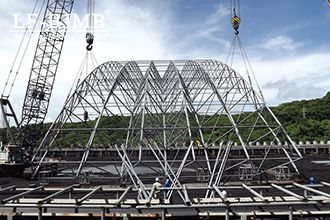
(1) Elevated Assembly: Prioritize the installation of main beams and columns to form a stable framework system — first hoist and temporarily secure the steel columns, then connect the main beams to the columns. Once the core framework is established, gradually install secondary beams and purlins to prevent local structural instability;
(2) Joint Connections: Bolt connections must be tightened and inspected using a torque wrench according to the design torque; any non-compliant connections must be reworked; Clean the weld joints before welding; inspect weld height and appearance after welding, and perform non-destructive testing if necessary; simultaneously monitor joint verticality, ensuring deviations remain within code limits;
(3) Component Alignment: Use a total station to monitor component deformation in real-time during installation. If verticality deviations or displacement occur, adjust using methods such as jacking or cable tensioning. Secure components promptly after correction to prevent secondary deformation.
3. Key Safety Construction Points
Steel structure construction often involves work at heights, so safety management must be maintained throughout the entire process:
(1) Personal Protection: Workers must wear hard hats, double-hook safety harnesses, and non-slip shoes at all times. When moving at heights, they must walk along safety ropes; climbing components without protective equipment is strictly prohibited;
(2) Site Protection: Rigid barriers and safety warning signs must be installed below work areas at heights. Safety nets must be installed over work surfaces at heights of 2 meters or more, and guardrails must be installed at edges and openings to prevent falls;
(3) Work Procedures: During welding operations, ensure adequate ventilation in the work area to prevent the accumulation of toxic gases. Additionally, cables must be laid out properly to prevent electrical leakage caused by crushing or abrasion. Immediately suspend work at heights in the event of severe weather conditions such as strong winds or heavy rain.
4. Application of Digital Technologies
Today, BIM technology and digital construction management have become indispensable tools for steel structure installation: simulating installation processes using BIM 3D models allows for the early detection of component interference issues; utilizing digital platforms to track material transportation and installation progress ensures transparency throughout the construction process; and employing smart monitoring devices to collect real-time structural deformation data reduces human measurement errors, thereby enhancing construction efficiency while adding an extra layer of safety assurance.
Adhering to the above installation guidelines and safety practices ensures the quality of steel structure installation while minimizing safety risks, thereby safeguarding the smooth progress of the project.


