







 About Us
 2026-03-23
1. Starting with the “Insoles of Bridges”
Imagine you’re walking a long distance in a new pair of shoes. What makes them most comfortable? It’s not the shoes’ stylish appearance, nor the durable material of the soles, but rather that seemingly unremarkable insole. It silently bears your entire body weight, cushions the impact of every step, and even adjusts to fit the shape of your foot—without it, even the finest shoes would make walking a struggle.
The transition plate in steel structure bearings plays exactly this “insole” role.
Beneath the majestic grid roof of a sports arena, this seemingly unremarkable steel plate component, though ordinary in appearance, shoulders a threefold mission:
(1) Error Compensation
Just as an insole can fill the slight gaps in a shoe, the transition plate uses carefully designed elliptical holes (with a diameter at least 10 millimeters larger than the anchor bolt) to effortlessly resolve the unavoidable positional deviations of embedded parts during construction. According to Clause 5.9.11 of the “Technical Specifications for Spatial Grid Structures” (JGJ 7-2010), this design significantly reduces the stringent requirements for civil construction precision, ensuring that “millimeter-level” installation errors no longer become a bottleneck for project progress.
(2) Force Balancing
When the weight of hundreds of tons of steel structures is concentrated and transferred to the concrete foundation, the transition plate acts like an insole that distributes pressure under the foot. Through reasonable thickness design (the pressure bearing plate should not be less than 12 mm) and local bearing capacity calculations, it ensures uniform load transfer and prevents the risk of concrete surface crushing.
(3) Deformation Coordination
Temperature fluctuations cause steel structures to expand and contract. The rubber pads or sliding mechanisms installed between the transition plate and the bearing base plate function much like the elastic layer of an insole, allowing the bearing to undergo slight rotation and horizontal displacement. This effectively releases thermal stress and prevents cracks caused by structural “restriction.”
2. Design Principles and Functions of Transition Plates
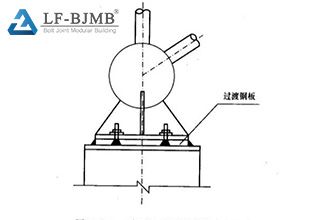
The design principle of transition plates can be summarized as “an adjustable intermediate component that coordinates construction tolerances with load transfer requirements.” This seemingly simple steel plate component actually embodies a sophisticated balance of mechanics and engineering ingenuity.
Core Logic of the Design Principle
The design of transition plates follows the basic principle of “prioritizing tolerance adjustment and optimizing load transfer paths.” Its core logic is reflected in:
(1) Indirect Load Transfer Mechanism
· The transition plate serves as an intermediate load-transferring component between the bearing base plate and the supporting surface top plate
· It connects to the bearing base plate via countersunk bolts and to the supporting surface top plate via side welds or groove welds
· This indirect force transmission method offers greater flexibility than direct alignment with anchor bolts, allowing it to accommodate various construction deviations
(2) Material and Structural Matching
· Transition plates are typically fabricated from steel plates, with thickness determined by structural calculations
· The thickness of the shim plate is generally 0.7 to 1.0 times that of the bearing base plate
· Anchor bolt hole diameters are designed to be 1–2 mm larger than the anchor bolt diameter to ensure installation flexibility
3. Detailed Explanation of the Four Major Functions
(1) Compensating for Construction Deviations and Simplifying Installation
This is the most direct manifestation of the transition plate’s function:
Elliptical hole design: Elliptical holes or large-diameter anchor holes are provided on the transition plate, with diameters exceeding the anchor bolt diameter
Position adjustment capability of over 10 mm: When there is a deviation between the bearing base plate and the embedded anchor bolt position, the shim plate adjusts the horizontal position, reducing precision requirements: This significantly reduces reliance on civil construction precision and avoids schedule bottlenecks caused by “millimeter-level” installation deviations
Code basis: Article 5.9.11 of the “Technical Specifications for Spatial Grid Structures” (JGJ 7-2010) explicitly stipulates this adjustment mechanism.
(2) Improved load-bearing performance and optimized force transmission
Transition plates play a critical role in mechanical performance:
For nodes with large reaction forces:
· In nodes with significant bearing reaction forces, such as those in three-dimensional tubular trusses, transition plates (e.g., curved shims) can reinforce member cross-sections
· Prevent primary welds from intersecting members, significantly improving the stress state of the node
Shear resistance assurance:
· In shear-resistant bearings, the transition plate is welded to the embedded parts to ensure effective transmission of horizontal shear forces
· Prevents bending of anchor bolts, ensuring structural safety
(3) Accommodating deformation requirements and releasing thermal stresses
Transition plates are essential for the structure’s “breathing”:
Minor rotational capacity:
· In plate rubber bearings, rubber shims are placed between the transition plate and the bearing base plate
· This enables the bearing to accommodate slight rotation and horizontal elastic displacement
Temperature Stress Relief:
· In double-curved bearings, elliptical openings are provided in the transition plate
· This allows the space frame to undergo horizontal displacement due to temperature changes
· Effectively relieves temperature stress and prevents structural cracking
(4) Enhancing Joint Stiffness and Stability
The transition plate makes a significant contribution to overall stability:
Formation of Rigid Bearings:
· Welded to stiffeners and vertical support plates to form a rigid bearing
· Ensures the overall stability of the joint under bending moments and shear forces
Reinforcement and repair functions:
· During reinforcement projects, the transition plate can replace damaged anchor bolts
· Restores the bearing’s tensile and shear resistance
Applicable scenarios and design principles
Main applications:
Pressure-bearing support joints: Particularly suitable for spatial grid structures such as space frames
Long-span structures: When support reactions are large or spans are extensive
Temperature-sensitive structures: Applications requiring accommodation of thermal deformation or horizontal displacement
Key Design Principles:
(1) Clear load transfer path: Ensure loads are effectively transferred from the superstructure to the foundation via the transition plate
(2) Rational and flexible construction: Hole placement must allow for sufficient adjustment allowance
(3) Strength and Stiffness Matching: Thickness selection must meet local bearing and bending resistance requirements
Although small in size, the design principles and functional role of the transition plate embody the wisdom of steel structure connections. It serves not only as a “compensator” for construction tolerances but also as an “optimizer” for force transmission. While ensuring structural safety, it significantly enhances construction convenience and cost-effectiveness.


