




 About Us
 2026-04-01
In 1882, the British engineer R.W. Little established China’s first thermal power station in Shanghai, which led to the emergence of coal shed structures. Over the following century, coal storage in China was predominantly carried out in open-air or semi-open-air facilities. However, open-air storage has the following drawbacks:
(1) Coal dust pollutes the surrounding environment;
(2) Exposure to sun and rain causes significant fluctuations in the moisture content of the coal piles, leading to severe loss of coal tar and a reduction in the coal’s thermal efficiency;
(3) Open-air coal storage is prone to spontaneous combustion.
To improve coal quality, reduce pollution of the surrounding environment, implement the national green development strategy, and fully comply with the requirements of ecological civilisation, enclosed coal sheds began to be gradually introduced in China during the 1980s. With the development of coal stacking and retrieval processes and the continuous expansion of unit capacity, demands on the span, storage capacity and safety of coal sheds have grown increasingly stringent. Consequently, the structural forms of coal sheds have evolved to meet the requirements of new processes and policies.
Classification of Coal Shed Structural Forms
Planar Structures
Prior to the 1980s, coal sheds in China predominantly employed portal frame or planar arch structural systems, such as the dry coal shed at the Jianbi Power Station in Zhenjiang, Jiangsu (double-hinged arch). However, portal frames have relatively short spans, whilst flat arch structures require significant amounts of steel (typically >100 kg/m²). Due to considerations regarding production processes and economic viability, such structural forms are generally not used in enclosed coal sheds today.
Bolted Structures
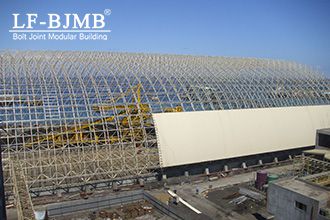
These consist of spatial truss structures connected via joints, offering advantages such as high rigidity, outstanding overall performance, rational distribution of forces, and relatively convenient installation and construction. The coal shed for Phase I of the Zhanjiang Power Station, commissioned in 1995, was situated on an artificial beach formed by land reclamation and is located in a typhoon-prone area. As the foundation supports struggled to withstand the thrust at the arch feet caused by wind loads, the original semi-circular arch structure was modified to a four-column supported flat space frame structure. However, with the continuous development of stacker-reclaimer processes within coal sheds, flat plate truss structures have proven to be less adaptable. Their lower chord elevations are often high, which is unfavourable for controlling wind load calculations, and they offer low space utilisation, resulting in relatively poor economic efficiency for this type of dry coal shed structure. Consequently, they are now gradually being phased out.
Shell Structures
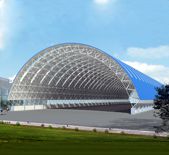
A shell is a curved spatial grid structure that combines the simple construction of a truss structure with the rational stress distribution of a thin-shell structure. Although dry coal shed structures have large spans, their architectural functional requirements are not particularly high; their effective space is generally trapezoidal in shape, closely resembling a cylindrical arch-shaped cross-section. Tricentric cylindrical shell structures not only transmit horizontal thrust along the arc to the supports but also reduce the structural rise. Furthermore, orthogonally placed four-cornered conical shell structures distribute forces evenly, offer good spatial stiffness and are relatively economical. Consequently, the orthogonal, equiangular tetrahedral grid shell with a three-centre cylindrical surface is the most commonly used structural form in the field of dry coal sheds, as seen in the dry coal sheds at Beijing Huaneng Power Plant and Hunan
Yiyang Power Plant.
In addition to cylindrical grid shells, spherical grid shells are also a widely used structural form for dry coal sheds. Due to span limitations, spherical grid shell dry coal sheds primarily adopt a double-layer, equal-thickness grid shell structure, with the grid pattern predominantly consisting of orthogonal tetrahedrons. Spherical grid shell dry coal sheds can cover the maximum space with the minimum surface area, offering relatively large coal storage capacity. This structure also allows for near-complete enclosure, providing good environmental protection. The structural characteristics of the spherical grid shell itself also make it well-suited to resisting the adverse effects of wind loads, giving it strong disaster resistance.
Prestressed Structures
The current trend in coal shed development is towards large spans and high capacities, driven primarily by two factors: on the one hand, as the unit capacity of thermal power plants increases, power stations must expand their coal storage capacity to achieve better economic returns and reduce coal transport costs; on the other hand, the actual dimensions of the bucket wheel stackers and reclaimers used for coal stacking and retrieval within coal sheds have reached the hundred-metre scale. To ensure sufficient space within the coal storage shed for coal stockpiling and equipment operation, the span of the shed must also be increased accordingly.
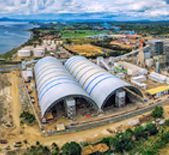
Currently, the span of newly constructed coal storage sheds can exceed 200 metres, and conventional spatial grid shell structures are no longer sufficient to meet process requirements. When the span of a coal shed exceeds 150 metres, the most commonly used structural form is the prestressed tubular truss structure. This is based on a conventional tubular truss structure, with prestressed cables installed at both ends of the truss and connected to the truss via struts, forming a self-balancing system comprising bending members (trusses), compression members (struts) and tension members (cables). The advantages of this structural form are as follows: by arranging and tensioning the cables, an upward equivalent prestress load is generated, effectively controlling the vertical displacement of the truss, reducing the internal forces within the truss structure, and minimising the horizontal thrust exerted by the truss structure on the foundation. Consequently, the dimensions of the foundation supports and the amount of structural steel required are reduced, yielding significant economic benefits. However, prestressed tubular truss structures also have limitations, including high welding difficulty, complex node layout, and stringent requirements for structural calculation and analysis. Examples of structures employing this form include the dry coal sheds at Wangtan Power Station and Leizhou Power Station.
Inflatable Membrane Structures
With the continuous advancement of membrane and cable materials technology, inflatable membrane structures have in recent years emerged as a structural form for large-span coal sheds. The structural principle involves inflating a sealed space formed by polymer composite membrane materials and maintaining a specific pressure differential between the interior and exterior of the sealed space. This system utilises internal pressure to maintain the membrane’s tension, resist external loads and sustain the structural form. As air-supported coal sheds are beam- and column-free and require no rigid supports, they offer high cost-effectiveness and short construction periods. However, the load-bearing capacity of air-supported structures is limited by the materials themselves; wind and snow loads can easily cause membrane rupture or loss of performance. Furthermore, during the operational phase following construction, there are drawbacks such as high electricity consumption and unstable air pressure, and maintenance costs are higher than those of steel-structured coal sheds. China’s first air-supported coal shed was the Shenhua Bayannur Coal Preparation Plant (2012), whilst the first phase of the fully enclosed air-supported coal yard at the Daihai Power Plant in Inner Mongolia features a span of 200 metres (2021).
Summary
Since the 1980s, the technical standards for large-span enclosed coal storage structures in China have continued to improve. The span of coal storage facilities has increased from tens of metres to over 200 metres, whilst steel consumption has decreased from 100–200 kg/m² in early planar arch designs, to 30–60 kg/m² in cylindrical and spherical grid-shell structures, and more recently, the use of air-supported membrane materials has replaced traditional steel structures, significantly reducing construction costs. When selecting a structural form for a coal shed, it is recommended to conduct a comparative analysis of process performance, economic indicators and environmental factors.


