






 About Us
 2026-07-10
In the construction of coal storage projects, the span of the storage shed is a core parameter determining storage capacity, the operational efficiency of machinery, site utilization rates, and overall investment costs, it is also a key focus for project owners, procurement teams, and design engineers. Developers frequently inquire about maximum applicable spans, economically optimal specifications, and standardized design approaches for large-span sheds. Drawing on industry-standard engineering experience, this article systematically outlines typical span ranges, application scenarios, selection logic, and design principles for large-span structures.
1. What is the span of a coal storage shed?
The span of a coal storage shed refers to the clear horizontal distance between the primary supporting structures on either side of the building; in simpler terms, it represents the width of the unobstructed interior space available for movement and material stockpiling. Span is a critical indicator of a shed’s operational performance. Within a reasonable design range, a larger span provides more open interior space and greater operational freedom for large-scale stacking, reclaiming, and loading equipment. It also increases overall storage capacity and site utilization, making it better suited for modern, mechanized, and large-scale coal storage operations.
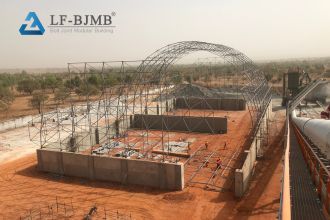
2. Typical span ranges and application scenarios
Based on experience with industrial projects in China, coal storage shed spans fall into four mainstream categories, catering to storage needs across various scales and industries.
The 30-meter to 50-meter range represents a small, conventional span. These structures are simple and cost-effective, making them suitable for small-to-medium industrial storage scenarios. They are commonly used for small coal yards, cement plants, and coal storage facilities supporting small and medium-sized factories, effectively meeting basic material turnover and storage requirements.
The 50-meter to 80-meter range is currently the most widely used mainstream span category in the industry. It offers an excellent balance of structural safety, spatial utility, and construction economy. Highly versatile, it is primarily suited for conventional industrial coal storage projects—such as those at thermal power plants, steelworks, and large industrial parks—and accommodates standard mechanized stacking and reclaiming operations. Spans ranging from 80 to 120 meters fall into the large-span category, offering greater structural load-bearing capacity and spatial volume. Suitable for large-scale warehousing scenarios, they are widely implemented in high-capacity, high-turnover projects such as major coal storage bases, port bulk material yards, and specialized bulk storage centers.
Designs exceeding 120 meters are classified as ultra-large-span coal storage silos. These demand exceptionally high standards for structural design, construction techniques, and load verification. They are primarily applied in key projects—such as major coastal ports, centralized large-scale coal storage hubs, and national-level energy storage and transport facilities—to meet high-end requirements for massive storage capacities and integrated, centralized operations.
3. Core reasons why large-span coal storage silos have become the industry standard
Currently, an increasing number of industrial coal storage projects prioritize large-span designs, driven primarily by advantages in operational efficiency and long-term economic benefits. Large-span silos enable column-free interior layouts, completely eliminating the space occupied by support pillars; this significantly boosts overall storage space utilization and maximizes the usable area for material stockpiling. Furthermore, the unobstructed interior space accommodates the flexible, full-range operation of large loaders, automated stacker-reclaimers, and conveyor systems. This prevents issues such as equipment collisions or operational constraints, thereby effectively enhancing productivity.
In terms of long-term operations, large-span layouts reduce wear and tear caused by equipment interference, simplify on-site management, and lower labor and equipment operating costs. Additionally, the flexible site layout provides ample room for future capacity expansion, process optimization, and equipment upgrades, resulting in superior project adaptability and scalability.
4. Key factors influencing coal storage silo span design
The span of a coal storage silo is not selected arbitrarily; it requires a comprehensive assessment based on specific project conditions.
First is the storage capacity requirement: the planned total coal volume and material turnover cycle directly determine the necessary stockpile area and serve as the fundamental basis for selecting the span. Second is site conditions: factors such as site dimensions (length and width), topography, and foundation bearing capacity constrain the maximum span, ensuring the structural layout aligns with actual site conditions. At the same time, the design must align with the on-site equipment layout. Factors such as the stacker-reclaimer’s operating radius, equipment specifications, and conveyor line configuration must be considered to determine an optimal span that ensures the smooth operation of machinery.
Furthermore, meteorological and geological parameters—such as local wind loads, snow loads, and seismic intensity—directly dictate structural load-bearing standards; the larger the span, the more rigorous the requirements for structural load performance. Finally, the project’s investment budget must be factored in to balance span specifications, structural costs, and operational benefits, ensuring the selection of the most economical and rational span solution while meeting safety and functional requirements.
5. Ensuring Safety in Large-Span Coal Storage Silos
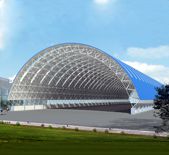
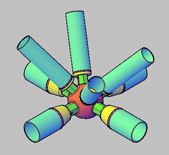
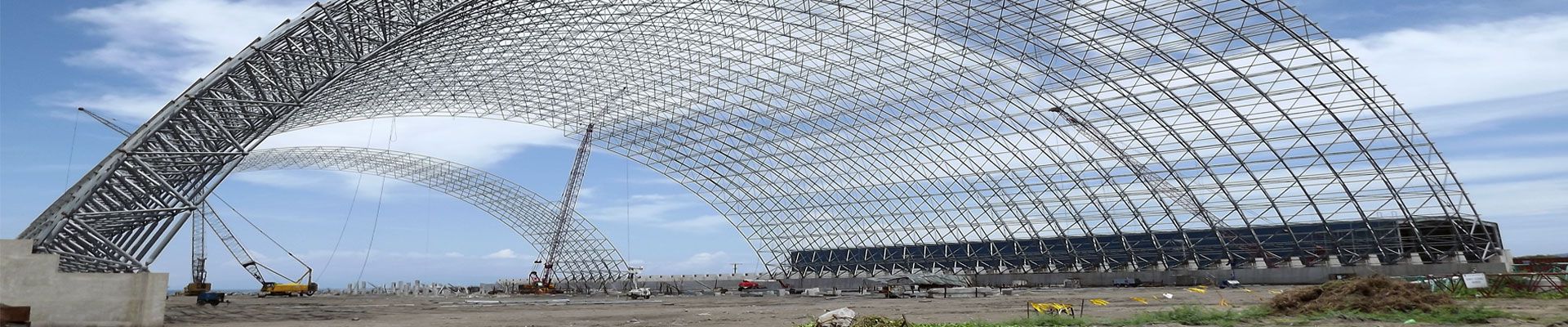
While large-span coal storage silos may appear to involve greater spatial volume and design complexity, they can achieve safe, stable, and long-term operation by leveraging mature modern spatial steel structure technologies. Mainstream spatial structural systems—such as domes and arches—feature uniform load distribution, high overall stability, and excellent wind and seismic resistance. These systems effectively mitigate the structural risks associated with large spans and are adaptable to diverse climatic and geological environments. Moreover, the successful implementation of large-span silos relies on professional management throughout the entire process. By combining precise load calculations, scientific structural system design, and refined joint optimization with standardized, high-quality factory fabrication and on-site installation, the structural strength, stability, and service life of the silo can be fully guaranteed, meeting the standards for long-term, safe industrial operation.
Conclusion
Span design is a core component of coal storage silo planning, directly determining the project’s storage capacity, operational efficiency, safety performance, and economic viability. A scientifically sound large-span design maximizes storage space, optimizes equipment operating conditions, and reduces long-term operating costs, all while ensuring structural safety and regulatory compliance. As industrial storage undergoes upgrades toward greater scale, mechanization, and sustainability, fully enclosed large-span coal storage silos—ranging from 30 to 150 meters—have become the mainstream trend for modern coal and bulk material storage projects.
Frequently Asked Questions (FAQ)
Q1: What is the maximum span achievable for a coal storage silo?
A: Current mature construction technologies in the industry enable the design and construction of ultra-large-span coal storage silos of 150 meters or more, fully meeting the needs of various massive energy storage and transportation projects.
Q2: Is a larger span always better for coal storage silos?
A: A larger span is not necessarily better; an excessively large span increases structural design and construction costs. Selection must be based on a comprehensive assessment of actual storage requirements, site conditions, and the investment budget, balancing safety, practicality, and cost-effectiveness.
Q3: Does a large-span design significantly increase construction costs?
A: A large-span layout slightly increases the consumption of steel materials and the complexity of design and construction; however, it significantly improves site utilization and operational efficiency while reducing long-term operating costs, resulting in superior overall benefits for large-scale projects.
Q4: Which structural forms are suitable for large-span coal storage silos?
A: Mainstream industry options—such as silo-type and dome-type coal storage structures—can accommodate large-span designs. The optimal choice depends on environmental requirements, site geometry, and the budget.
Q5: How can the appropriate span for a coal storage silo be precisely determined?
A: The optimal span specification is determined by integrating factors such as planned storage capacity, site dimensions, mechanical equipment parameters, local load conditions, and the investment budget, followed by a professional comparison of schemes and structural verification calculations.


