




 About Us
 2026-06-24
1. During installation, the placement of temporary supports must be handled with care. Before installation begins, the locations and elevations of the supports should be planned in advance. Temporary supports must ensure that the space structure is loaded evenly and that the forces on the members are consistent. Attention must also be paid to the stability of the temporary support bases (scaffolding), and care must be taken to prevent the supports from sinking.
2. Jacks can be used as supports for temporary supports, allowing for gradual adjustments during the installation process. Note that adjustments to temporary support points should not be limited to a single point; they must also consider the uniform distribution of forces across the surrounding space structure. Sometimes, such localized adjustments can cause individual members to deform or bend.
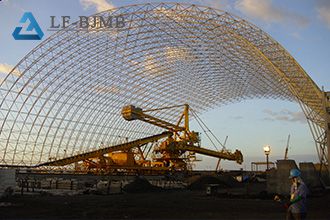
3. When dismantling temporary support points, ensure that multiple sets of support points are lowered simultaneously. During the lowering process, avoid excessive drops; instead, lower them gradually, section by section, in stages, and proportionally, or use an equal-step method with each step not exceeding 100 mm.
4. Pay attention to the load-bearing conditions of the supports. Some supports may be welded in place, while others should remain free ends, and still others require limit stops. Therefore, the construction of space structure supports must strictly follow design requirements.
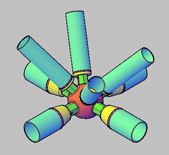
5. It is particularly important to consider the deformation caused by welding shrinkage when installing welded spherical space structures, especially for space structures hoisted as a single unit and modular space structures. After ground assembly, the amount of welding deformation and shrinkage must be accurately determined before welding begins. Since the weld points (heated surfaces) on a steel space structure are all located on the upper side of the planar structure during welding, the structure is prone to deformation due to unidirectional heating. Typically, after welding, the supports along the four peripheries will gradually lift upward. If the deformation is significant, it may offset the originally planned camber. If camber was not originally factored into the design, welding may result in significant deflection, which could affect compliance with quality acceptance requirements. Therefore, when constructing and welding spherical space frames, the deformation caused by unidirectional heating must be taken into account.


