






 About Us
 2026-04-10
Space structures can be classified into double-layer plate-type space structures, as well as single-layer and double-layer shell-type spatial structures. In plate-type space structures and double-layer shell-type space structures, the members are divided into upper chords, lower chords, and web members, which primarily resist tensile and compressive forces. The joints in single-layer shell-type spatial structures are generally assumed to be rigid, and calculations should be performed using the finite element method for rigid truss systems; Double-layer shell space structures can be calculated using the finite element method for hinged truss systems. Both single-layer and double-layer shell space structures can also be simplified using the pseudo-shell method.
In addition to tension and compression, members in single-layer shell space structures also experience bending moments and shear forces. Currently, the vast majority of spatial structures in China are plate-type space structures. Space structures are a type of spatial grid structure. The term “spatial structure” is used in contrast to “planar structure” and refers to structures that exhibit three-dimensional behavior. Since their introduction, spatial structures have been widely embraced for their efficient load-bearing performance, innovative and aesthetically pleasing forms, and rapid, convenient construction. Space structures can also be viewed as an extension and refinement of planar structures. Space structures are spatial truss systems in which members primarily resist axial forces and have relatively small cross-sectional dimensions.
Space structures have become one of the most widely used new structural types in the modern world. Research and adoption of space structures in China began in the 1960s. In recent years, the rapid development of electronic computing technology has resolved the computational challenges associated with highly statically indeterminate spatial structures, driving rapid advancements in both their design and practical engineering applications.
Space structures are ubiquitous in venues requiring large spans and expansive spaces, such as sports arenas, convention centers, cultural facilities, transportation hubs, and even industrial plants. The advantages of spatial structures include low steel consumption, excellent structural integrity, rapid fabrication and installation, and the ability to accommodate complex plan forms. They are suitable for structures of various spans, particularly those with complex plan geometries. The intersecting members mutually support one another, organically integrating load-bearing members with the support system, thereby achieving material efficiency.
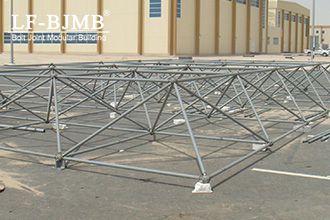
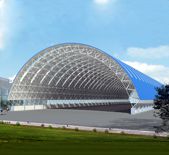
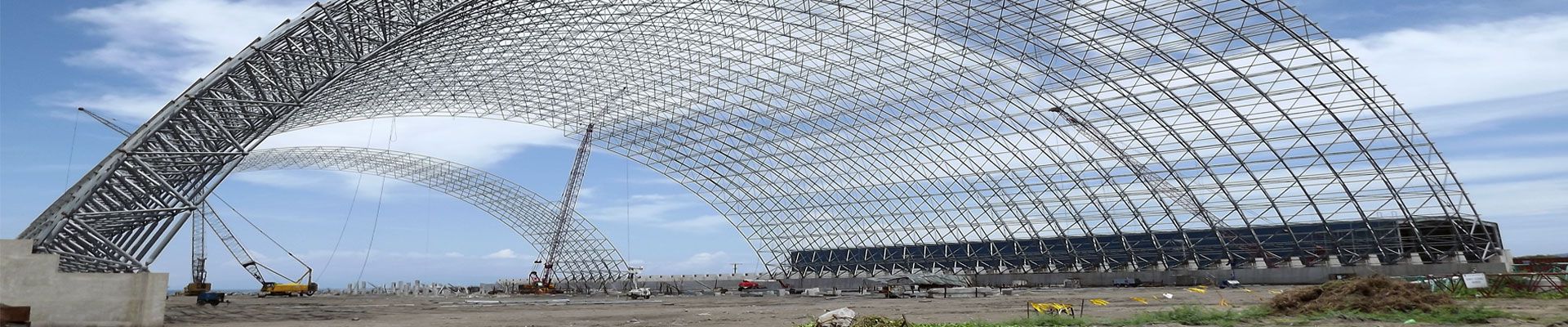
Space structures are primarily used in large- and medium-span public buildings, such as gymnasiums, aircraft hangars, clubs, exhibition halls, and waiting halls; they are also increasingly being adopted in small- and medium-sized industrial plants. The greater the span, the more significant the advantages and economic benefits of using this type of structure become. Spatial structures are primarily classified into three categories based on their configuration: The first category consists of planar truss systems, which include four forms: two-way orthogonal upright spatial structures, two-way orthogonal inclined spaced structures, two-way oblique inclined spaced structures, and three-way space structures; The second category consists of tetrahedral units, comprising five forms: orthogonally oriented tetrahedral spatial structures, orthogonally oriented hollow tetrahedral spatial structures, obliquely oriented tetrahedral spatial structures, checkerboard-patterned tetrahedral spatial structures, and star-shaped tetrahedral spatial structures; The third category consists of triangular pyramid units and includes three forms: triangular pyramid space structures, hollow triangular pyramid space structures, and honeycomb-shaped triangular pyramid spatial structures. Shell-type space structures are primarily classified by shell surface form into cylindrical shell spatial structures, spherical shell spatial structures, and hyperbolic parabolic shell spatial structures. Based on the materials used, spatial structures are classified into steel space structures, reinforced concrete space structures, and composite space structures made of steel and reinforced concrete, with steel space structures being the most commonly used.
Depending on their external shape, space structures can be divided into double-layer plate-type spatial structures, as well as single-layer and double-layer shell-type spatial structures. The members of plate-type spatial structures and double-layer shell-type space structures consist of upper chords, lower chords, and web members, which primarily bear tensile and compressive forces; the members of single-layer shell-type spatial structures, in addition to bearing tensile and compressive forces, also bear bending moments and shear forces. Currently, the vast majority of space structures in China adopt plate-type space structures.
By actual application: A spatial structure consists of multiple members connected through joints in a specific grid pattern. They offer advantages such as spatial load-bearing capacity, light weight, high rigidity, and excellent seismic performance; they can be used as roof structures for buildings such as gymnasiums, theaters, exhibition halls, waiting halls, stadium grandstand canopies, aircraft hangars, and workshops with large-span, two-way column spatial structures.
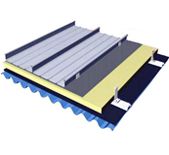
Space structures are characterized by light weight, high strength, good overall rigidity, and strong deformation capacity; currently, the demand for space structures is also growing. The structural roof is entirely composed of a cold-formed thin-walled steel component system. The steel framework is manufactured using super-corrosion-resistant, high-strength cold-rolled galvanized steel sheets, effectively preventing rust damage during construction and use, thereby extending the service life of the light steel components. The structural lifespan can reach 100 years.
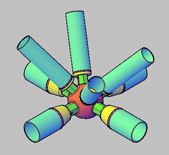
The thermal insulation material used in steel space structures is primarily fiberglass wool, which provides excellent thermal insulation. The insulation panels used for exterior walls effectively prevent “thermal bridging” in the walls, achieving superior thermal insulation performance. The assembly of space structures is generally performed on-site. Prior to shipment, spatial structures with bolted spherical joints should undergo pre-assembly to verify component dimensions and check for deviations.
Depending on the construction and installation methods, the assembly of space structures may be carried out in sections, in blocks, or as a whole. The assembly of space structures should be performed on a level, rigid platform. When assembling space structures with welded hollow spherical nodes, the assembly sequence should be carefully selected to minimize welding deformation and residual stresses. Based on LFBJMB’s experience across multiple projects, the welding sequence should proceed from the center outward toward the sides or all four sides; proceeding from the center toward the sides is preferable, as this allows the ends and front of the structure to contract freely during forward assembly.


