





 About Us
 2025-12-10
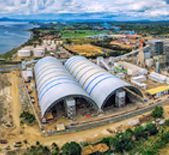
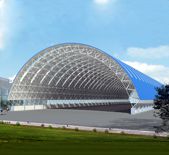
As large-scale public buildings, sports venues demand high standards for spatial span and occupancy capacity, making their fire safety planning a critical focus. Steel structures provide effective support for large-span spaces due to their outstanding mechanical properties. However, the degradation of these properties under high temperatures poses significant challenges to venue safety design. Therefore, innovative practices and optimized applications of steel structure fire protection technologies are crucial for enhancing the safety standards of sports venues.
Fire protection challenges in sports venues manifest prominently in three aspects: First, large-span spaces create complex fire spread pathways, complicating fire suppression efforts. Second, dense crowds demand rapid evacuation during fires, placing higher demands on structural stability windows. Third, fire standards must be balanced with architectural aesthetics and functional design. Steel structure fire protection technology must overcome technical hurdles like high-temperature stability, fire resistance duration, and construction adaptability to meet the unique needs of sports venues.
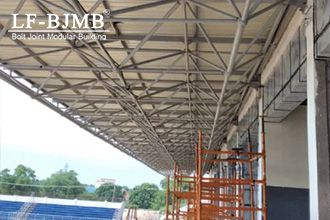
A large-scale sports venue has set an industry benchmark through innovative application. The facility employs a new type of intumescent fireproof coating that rapidly expands into a heat-insulating carbon layer when exposed to high temperatures. This is integrated with an intelligent temperature control system that continuously monitors temperatures, triggering alerts and activating fire suppression systems upon exceeding critical thresholds. This solution extends the fire resistance rating of the steel structure to over 3 hours. Additionally, the coating’s eco-friendly formulation and light-colored appearance achieve both environmental sustainability and aesthetic appeal.
From a product perspective, steel structure fireproof coatings for stadiums must possess three key characteristics: first, excellent weather resistance to withstand outdoor or high-humidity environments; second, thin-layer efficiency to avoid adding structural load; third, easy application for uniform coverage on complex steel joints. During construction, coating thickness and curing time must be strictly controlled. Combined with pretreatment processes like sandblasting for rust removal, this ensures the fireproof coating bonds tightly with the steel structure, forming lasting protection.
With the booming development of the sports industry, the demand for fire protection technology in venues is evolving from mere compliance to intelligent early warning and proactive defense. Steel structure fire protection technology will advance toward lightweight, long-lasting, and intelligent solutions, integrating with IoT systems to build smart fire protection networks.


