




 About Us
 2025-12-08
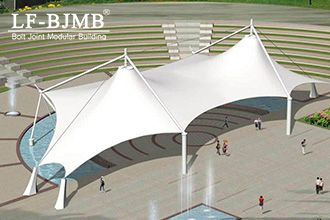
As a vital component of membrane structures, membrane materials for carports must be waterproof, windproof, and impermeable. They should also exhibit high tensile strength, appropriate elongation, abrasion resistance, and resistance to mechanical damage. Architectural membrane materials endure prolonged exposure to sunlight, wind, and rain during use, demanding excellent weather resistance, high and low temperature tolerance, corrosion resistance, and mold prevention. They resist degradation under prolonged sunlight and acid rain exposure, maintain dimensional stability under tension and weather impact, and exhibit minimal deformation or elongation across wet and dry conditions.
1. Durability
The base fabric of membrane materials is lightweight yet possesses high mechanical strength, showing no significant stress relaxation or creep under prolonged loading. Medium-strength PVC membranes, at 0.61mm thick, possess tensile strength equivalent to half that of steel. Medium-strength PTFE membranes, only 0.5mm thick, achieve tensile strength on par with steel. PTFE-coated fiberglass membranes have a lifespan of up to 40 years, while PVDF-coated polyester membranes last 15 years.
2. Light Transmission and Thermal Conductivity
Membrane materials filter out most ultraviolet rays, preventing fading of interior items. Their natural light transmittance reaches 20%, producing uniform diffuse illumination within the structure—free of shadows or glare, with excellent color rendering. At night, backlit surfaces glow, transforming buildings into iconic urban landmarks. PTFE-coated fiberglass membranes reflect 73% of light and transmit only 13%, significantly reducing heat transfer. Under intense sunlight, the membrane surface temperature rises only 2–3°C above ambient air temperature. In contrast, conventional glass or polycarbonate panels transmit up to 80% light, causing substantial internal temperature increases. Adding an insulating inner membrane beneath the structural membrane further enhances thermal performance. Double-layer membrane roofs are highly suitable for regions with extreme cold or heat. The thermal insulation performance of single-layer membrane materials is equivalent to brick walls and superior to glass. Similar to other building materials, membrane structures can also utilize additional methods to regulate internal temperatures, such as installing internal insulation layers or employing air conditioning and heating systems.
3. Fire Resistance
Modern membrane materials widely used today effectively meet fire safety requirements, featuring flame-retardant and high-temperature resistance properties. They comply with standards set by multiple countries including France, Germany, the United States, and Japan.


