






 About Us
 2026-05-22
Many people believe that “I-beam” is the domestic term and “H-beam” is the international term, but this is actually a misconception. H-beams and I-beams differ in both shape and load-bearing characteristics.
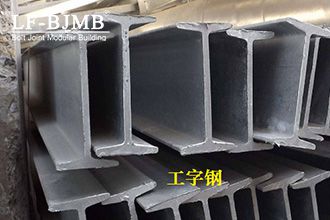
I-Beams:
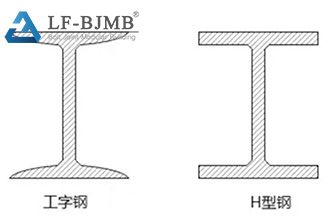
As the name suggests, an I-beam is a structural steel with an “I”-shaped cross-section. The inner surfaces of the upper and lower flanges have a taper (as shown in the figure below), typically at a ratio of 1:6, making the flanges thinner on the outside and thicker on the inside. I-beams are classified into standard I-beams, light-duty I-beams, and wide-flange I-beams. Based on the ratio of flange height to web height, wide-flange I-beams are further categorized into wide, medium, and narrow types.
H-Beams:
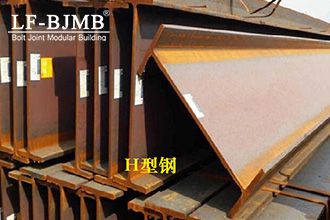
H-beams are named for their cross-sectional shape, which resembles the letter “H” (as shown in the figure below). Since all components of an H-beam are arranged at right angles to one another, as illustrated above, they offer advantages such as strong bending resistance in all directions, simple construction, cost-effectiveness, and lightweight structure. Consequently, they have been widely adopted.
It differs from I-beams in several ways: first, the flanges; second, the inner surface of the flanges is not sloped, with the upper and lower surfaces being parallel. Its cross-sectional properties are significantly superior to those of traditional I-beams, channel sections, and angle sections.
Differences and Applications of H-Beams and I-Beams
1. Because I-beams have relatively tall and narrow cross-sections, they are generally only suitable for use in members subjected to bending within the plane of the web or for forming lattice-type load-bearing members. They are not suitable for axially compressed members or members subjected to bending perpendicular to the plane of the web, which significantly limits their scope of application.
2. Due to their rational cross-sectional shape, H-beams allow steel to perform more efficiently, thereby increasing load-bearing capacity. Unlike ordinary I-beams, H-beams feature widened flanges, and their inner and outer surfaces are typically parallel, facilitating connection to other components using high-strength bolts. They are available in a rational series of sizes with a complete range of models, making them convenient for design and selection (except for I-beams used in crane beams).
3. I-beams have small flange widths and great depths, allowing them to withstand forces in only one direction; H-beams have deep flanges and greater thickness, enabling them to withstand forces in two directions.
4. I-beams can only be used as beams, whereas H-beams can be used as load-bearing columns in structures.
5. I-beams perform well under vertical compression and have good tensile strength, but their narrow flanges limit their torsional resistance; H-beams, conversely, offer greater torsional resistance. Each has its own advantages and disadvantages. H-beams have wider flanges than I-beams, greater lateral stiffness, and stronger bending resistance; for the same specifications, H-beams are lighter than I-beams.
Applications:
HW, HM, and HN are general terms for H-beams; H-beams are welded, while HW, HM, and HN are hot-rolled.
HW refers to H-beams where the height and flange width are roughly equal; they are primarily used as steel-core columns in reinforced concrete frame structures, also known as rigid steel columns. In steel structures, they are mainly used as columns.
HM is primarily used in steel structures: as columns in steel frames, and as frame beams in structures subjected to dynamic loads. For example: equipment platforms. HN is an H-beam with a height-to-flange width ratio of 2 or greater, primarily used for beams; the applications of I-beams are equivalent to those of HN-beams.


