




 About Us
 2025-11-10
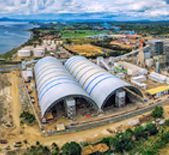
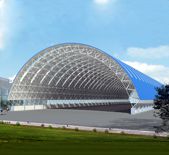
In recent years, with the rapid development of my country’s economy and construction technology, various forms of steel structures have been widely used in large-space buildings such as stadiums, airports, railway stations, equipment production lines, convention centers, and theaters, with tubular truss structures being particularly prevalent. Why are tubular trusses widely used in large-space buildings?
Tubingas are favored in large-space buildings primarily due to their excellent load-bearing and stability performance.
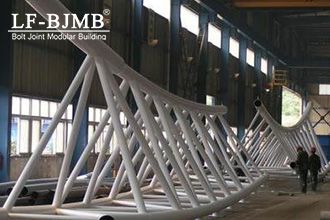
The structural forms of tubular trusses can be classified according to their cross-sectional shape, including triangular space trusses, quadrilateral space trusses, polygonal space trusses, and variable cross-section space trusses.
Compared to traditional open-planar trusses, tubular trusses, because their three chords are not in the same plane and are three-dimensional structures, have greater lateral stiffness and out-of-plane stability, reducing lateral supports and saving steel. Furthermore, the material in the cross-section of a tubular truss structure is uniformly distributed around its axis, resulting in good all-directional stability, structural symmetry, a large radius of gyration, and excellent load-bearing performance. Furthermore, the sealed ends of the steel pipes in the tubular truss effectively prevent rust and water accumulation inside the pipes, providing excellent corrosion protection.
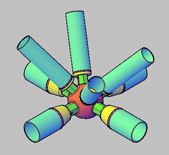
Compared to space frame structures, tube truss nodes do not have intersecting welded joints with external components. This allows them to adapt to various structural forms, with arbitrary curved shapes such as arches, resulting in a smooth and aesthetically pleasing appearance. They also eliminate areas difficult to paint or prone to dust accumulation, facilitating later maintenance. Therefore, compared to some space frame fabrication manufacturers, they prefer tubular truss production, as the overall cost is lower from multiple perspectives. Additionally, trusses are unidirectional load-bearing structures, requiring fewer members than space frame structures for most unidirectional rectangular planar buildings, resulting in a lighter structure and greater material savings.


