






 About Us
 2025-10-24
Steel-structured factory buildings are increasingly favored due to their low cost and short construction cycles. However, after steel structures are put into use, issues such as insufficient structural strength may arise, necessitating stiffness and stability testing. If structural components fail during testing, reinforcement of the steel-structured factory building becomes required. Common reinforcement methods for steel structures include load reduction, increasing the cross-sectional area and connection strength of existing components, crack propagation prevention, localized reinforcement, overall reinforcement, loading reinforcement, unloading reinforcement, and foundation reinforcement. While these approaches are widely applied, the specific method selected depends on client preferences and engineering recommendations, with implementation tailored to actual conditions.
Reinforcement by Increasing Component Cross-Sections.
When reinforcing steel components by enlarging their cross-sections, the selected section form should align with the technical requirements of the reinforcement while accounting for existing defects and damage. Reinforcement of steel structures must be tailored to actual conditions, as quality requirements often vary across different sections. Therefore, appropriate reinforcement methods should be selected for different areas of the steel structure building.
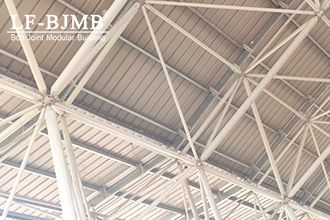
Strengthening Connections and Reinforcing Joints.
Connection methods for steel structures include welds, rivets, standard bolts, and high-strength bolts. Reinforcement should be determined based on structural requirements, including the reason for reinforcement, purpose, stress state, structural conditions, and construction constraints, while considering the original connection methods. Reinforcement typically employs welded connections or friction-type high-strength bolt connections; hybrid connections combining welded and friction-type high-strength bolts may be used as appropriate. During welding, approved welding procedures and connection materials must be employed. Connections in steel structures can be categorized into welded and non-welded sections. Welded sections may opt for reinforced welds, while non-welded sections may utilize friction-type high-strength bolts. Mixed reinforcement may be applied when structural reinforcement is required.
Structural failures in steel buildings, such as enlargement or brittle fracture due to repeated loading, improper material selection, design flaws, manufacturing defects, construction errors, or installation issues, necessitate repair measures. Prior to repair, analyze the causes and extent of cracks to implement targeted structural modifications or reinforcement. Components unsuitable for repair or reinforcement should be removed and replaced. Due to varying load pressures, many structural members sustain damage to differing degrees. Severely damaged components may be reinforced through replacement to enhance overall structural quality.
Local reinforcement targets individual members or connections with insufficient load-bearing capacity, achieved through adding member segments, reducing free member length, or strengthening joints.
Global reinforcement involves strengthening the entire structure, employing methods such as static calculation diagram reinforcement or static calculation diagram reinforcement. Reinforcement can also be achieved by adding or strengthening the support system.
Load-bearing reinforcement offers simple construction and cost-effectiveness, primarily applicable when member stresses are below 80% of the structural design strength or damage is minor. This involves temporarily unloading the reinforced member to transfer loads to the new reinforcement.
Unloading reinforcement is required when structural damage is significant or components/connections are under high stress, necessitating temporary load reduction.
For severely damaged structures or those with insufficient in-situ cross-sectional load-bearing capacity, temporary ground-based supports must be installed for reinforcement or replacement. This ensures components can be unloaded during replacement and that the entire structure remains unloaded during structural changes.
Overall, reinforcing light steel structures is complex and involves numerous considerations. Reinforcement methods should be selected based on construction convenience, minimal production disruption, economic rationality, and effective results.


