





 About Us
 2025-08-29
What are the installation methods for steel space frames?
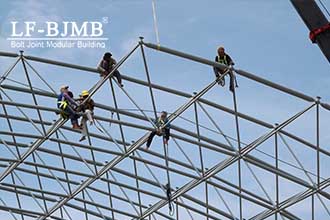
(1) High-Altitude Bulk Handling Method
Features: Direct assembly of truss members and nodes at their design positions without requiring large lifting equipment. Suitable for trusses with bolted spherical nodes, this method has low site requirements but involves significantly high-altitude work, resulting in relatively low construction efficiency and greater difficulty in quality control.
Suitable Scenarios: Small-scale space frames, projects with complex geometries, or sites with limited space.
Assembly Sequence: Assemble progressively from the center outward and from the bottom upward. First, install the lower chords and lower sphere joints, then install the diagonal members and upper chords. After forming stable triangular units, gradually expand outward.
(2) Section-by-section or block-by-block installation method
Features: The space frame is divided into multiple strip-shaped or block-shaped units. After assembly on the ground, these units are hoisted to their designated positions for connection. This approach reduces high-altitude work, enhances construction efficiency and safety, but imposes certain requirements on hoisting equipment. The design of the divided units and the treatment of connection nodes are critical.
Applicable Scenarios: Medium-span space frames where the weight of each segmented unit falls within the lifting capacity of the equipment.
Assembly Sequence: Fully assemble the strip or block units on the ground. After inspection and confirmation, hoist them into position. First connect the lower chords, then the diagonal chords and upper chords, ensuring all unit connections are secure.
(3) Aerial sliding method
Features: The space frame sections are slid along pre-installed rails at elevated heights, assembled, and connected after positioning. This method eliminates the need for large lifting equipment during construction, occupies minimal space, and is suitable for sites with limited construction areas. However, it demands high precision in rail installation and synchronized sliding.
Applicable Scenarios: Rectangular space frames with long building lengths and narrow widths.
Assembly Sequence: First, erect an assembly platform at one end of the structure. Assemble the truss strip units on the platform. Then, use traction equipment to slide the unit along the guide rails to its designated position. Repeat this process for subsequent units, assembling and sliding them into place. Finally, complete the connections between all units.
(4) Overall Lifting Method
Features: After assembling the space frame as a whole on the ground, it is lifted into position in one go using large-scale lifting equipment. This method offers high construction efficiency and effectively ensures installation quality, but it demands extremely high lifting capacity and hoisting skills from the equipment, along with a large ground assembly area.
Applicable Scenarios: Suitable for small to medium-sized space frames or large-scale structures where lifting equipment meets the requirements.
Assembly Sequence: Complete all frame assembly on the ground according to design drawings. Conduct a comprehensive inspection and acceptance of the assembled frame. Upon confirmation of accuracy, utilize lifting equipment to hoist the entire frame to its designated position for final installation and securing.
(5) Overall Enhancement Method
Features: After assembling the space frame on the ground, it is lifted to the design elevation as a whole using hoisting equipment installed atop building columns or other structures. This method eliminates the need for large-scale lifting equipment, offering higher construction safety. However, the layout of hoisting equipment and synchronized control present technical challenges.
Applicable Scenarios: Suitable for large-span, heavy-weight space frames and projects where the surrounding environment restricts the use of large cranes.
Assembly Sequence: Complete frame assembly on the ground. Install lifting equipment and rigging. Conduct a test lift to inspect stress distribution across all components. Upon confirmation, formally lift the frame to the design elevation and secure it in place.
(6) Overall Jacking Method
Features: Similar to the overall lifting method, the difference lies in positioning the jacking equipment beneath the space frame. Using jacks and other devices, the frame is gradually lifted to its designed position. Suitable for space frames with fewer support points, this method demands high load-bearing capacity from both the foundation and jacking equipment. Strict control over lifting synchronization and stability is required during construction.
Applicable Scenarios:
Large-span, low-height space frames and projects with stringent site requirements.
Assembly Sequence:
Assemble the space frame on the ground. Install lifting equipment and conduct a test lift to ensure even force distribution across all lifting points. Then, gradually lift the space frame to the design elevation according to the predetermined sequence. Finally, secure the structure in place.
Construction Key: The Art of Balancing Quality, Safety, and Schedule
During steel space frame construction, regardless of the installation method employed, the following key points must be strictly controlled:
Quality Control: From incoming steel material inspection and component machining precision to node connection quality and overall structural dimensional deviations, all must be rigorously inspected in accordance with national standards and design requirements to ensure compliance at every stage.
Safety Management:
High-altitude operations must implement comprehensive safety precautions, including safety nets, guardrails, and safety harnesses for workers. Lifting operations must strictly adhere to operating procedures, with regular inspections and maintenance of lifting equipment to ensure hoisting safety.
Schedule Management:
Reasonably arrange construction sequences and resource allocation. Develop detailed construction schedules and adjust them promptly based on actual conditions to ensure timely project completion.
Steel space frame structure engineering construction is an art that integrates mechanics, aesthetics, and engineering technology. As technology continues to advance, steel space frames will continue to innovate, creating more breathtaking architectural wonders for us.


