




 About Us
 2026-07-22
1. Enclosed Linear Coal Yard
1.1 Overview
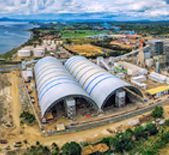
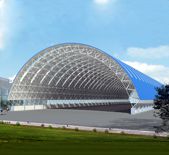
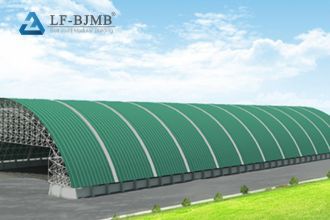
The cross-section of a pile in a linear coal yard is trapezoidal. The unit storage capacity of the coal yard increases with the height of the coal pile and the length of the cantilever of the cantilever bucket wheel stacker-reclaimer, but the recovery rate is only about 80 percent. The entire linear coal yard is covered by semicircular coal sheds; its external appearance is shown in Figure 3.
The cantilever bucket wheel stacker-reclaimer is the most commonly used machinery in linear coal yards. It primarily consists of a bucket wheel mechanism, a pitch mechanism, a slewing mechanism, a traveling mechanism, a cantilever belt conveyor, a tail car, a metal structure, and electrical equipment. The rotating components—including the bucket wheel mechanism, cantilever belt conveyor, slewing mechanism, and tilting mechanism—are mounted on a gantry, which travels along the track via the traveling mechanism. The stacker-reclaimer works in coordination with the main belt conveyor of the coal yard, which is arranged longitudinally, through the tail car. When stacking is required, the hydraulic cylinders move the tail car into the stacking position so that material arriving from the main belt conveyor of the coal yard can be discharged into the hopper via the head drum. The hopper is located at the center of the stacker-reclaimer, allowing material to be supplied to the cantilever belt conveyor from any position. Through the coordinated movement of the slewing mechanism and the traveling mechanism, material discharged by the cantilever belt conveyor can be unloaded across the entire stockpile on both sides of the track, while the tilting mechanism is used to adjust the height of the stockpile. During unloading operations, the hydraulic cylinders move the tail car into the unloading position, and the bucket wheel mechanism rotates the bucket wheel, allowing the buckets to cut into the stockpile and excavate material. The material falls by its own weight from the buckets onto a fixed trough, slides onto the cantilever belt conveyor, and is then fed into the main belt conveyor of the coal yard via the hopper. The bucket wheel stacker-reclaimer in the coal yard has three operating modes: semi-automatic operation, manual operation, and start/stop for maintenance. The equipment itself is equipped with an operator’s cab for on-site commissioning, operation, and maintenance.
1.2 Key Features
The civil engineering design, construction, equipment manufacturing, and installation for coal yards involve relatively low technical requirements. The equipment is highly localized, resulting in lower costs. Linear coal yards cover a large area, and since the coal sheds are directly open to the atmosphere, heat dissipates quickly, which helps prevent spontaneous combustion of coal. Coal storage and transshipment are flexible. However, these yards have low land utilization rates, occupy a large footprint, and involve significant earthwork and rock excavation. All coal yard equipment requires dedicated on-site operators, resulting in a low degree of automation. Coal yard operations involve a heavy workload, and the coal handling system requires a large number of personnel.
Rectangular coal yards are covered by a circular roof and feature windbreak and dust-suppression walls at both ends, resulting in minimal dust pollution. However, rectangular coal yards have a low recovery rate, and auxiliary machinery operates frequently, leading to high annual operating costs for such equipment.


