




 About Us
 2026-07-24
1. Overview
According to Article 8.4.2 of GB 50049—2011, *Design Code for Small Thermal Power Plants, “When a power plant is located in a region with high rainfall, a dry coal shed shall be provided based on factors such as coal characteristics, the combustion system, and the type of coal yard equipment; its capacity shall not be less than 4 days’ coal consumption for the entire plant; For power plants burning sticky coal, the storage capacity of the dry coal shed may be appropriately increased; for power plants using circulating fluidized bed boilers, the capacity of the dry coal shed should be 4 to 10 days’ worth of the plant’s total coal consumption.”
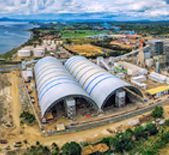
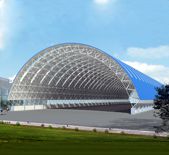
This project is a thermal power plant using circulating fluidized bed boilers, burning highly viscous petroleum coke and coal. As it is located in the rainy coastal region of Fujian, it is advisable to design an enclosed dry coal shed for coal storage; the exterior of the enclosed dry coal shed is shown in the figure.
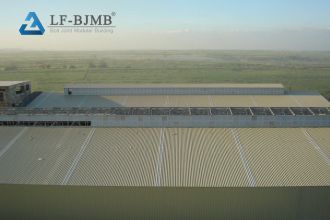
Based on the scale of the project, four enclosed dry coal sheds with a span of 33 m and a total length of 200 m will be constructed. The specific design parameters for a single bay of the dry coal shed are as follows: the dry coal shed has a span of 33 m, a total length of 200 m, a rail top elevation of 13.0 m, a beam bottom elevation of 16.5 m, a coal pile height of 7 m, and a coal retaining wall height of 4 m.
Each span of the dry coal shed is equipped with four grab bridge cranes with a span of 31.5 m and a lifting capacity of Gn = 10 t (grab volume V = 5.0 m³), which are responsible for coal stacking, feeding, and transfer operations within the dry coal shed. Additionally, coal pushers and loaders are installed in the coal yard to serve as auxiliary facilities for coal feeding and transfer. Each bay of the dry coal shed is equipped with four coal receiving hoppers, each with an inlet dimension of 4,400 mm × 4,000 mm, used for coal feeding. The receiving hoppers are arranged in parallel and correspond respectively to the vibrating coal feeder, the hopper arch-breaking device, and the coal conveyor belt; the vibrating coal feeder and conveyor belt are located within the underground passage of the dry coal shed.
To prevent spontaneous combustion of the coal, the coal in the yard must be used in the order it was received during operation—that is, on a first-in, first-out basis—to ensure that the coal is not stored in the yard for too long. When the coal is stacked, it is compacted in layers using a coal pusher. Sprinkler systems are installed around the coal yard to periodically spray water on the coal and suppress dust. Fire monitors are installed within the coal yard. Outdoor fire hydrants are installed around the perimeter of the coal yard, and the coal retaining walls feature access passages for coal pushers to enter and exit the yard. In the event of spontaneous combustion, water is first sprayed to extinguish the fire, then the coal pusher is used to move the burning coal away, compact it, and finally return it to the coal pile.
2. Key Features
The civil engineering design, construction, equipment manufacturing, and installation for the coal yard involve relatively low technical requirements; the equipment is highly localized, resulting in low costs; In dry coal sheds, the low stacking height facilitates rapid heat dissipation, which helps prevent spontaneous combustion of coal; coal storage and transshipment are flexible, allowing for controlled water management and drying through batch unloading. However, the land utilization rate of such yards is low, they occupy a large area, grab cranes have low material handling efficiency, coal feeding capacity is limited, auxiliary machinery operates frequently, and the annual operating costs for auxiliary machinery are relatively high.
From a technical and economic perspective: enclosed circular coal yards store more coal per unit area, require less land, feature a high degree of automation, and have an aesthetically pleasing appearance. However, when storing high-volatility coal, they are prone to spontaneous combustion, making fire prevention challenging; there are no backup stacker-reclaimers, and they lack the ability to separate piles or turn and sun-dry the coal; Although enclosed linear coal yards allow for segregated stacking, they occupy a large area; bucket wheel stackers and reclaimers cannot load and unload simultaneously, nor can they perform functions such as sun-drying and moisture control. Considering the fuel characteristics of this project, the rainy climate, the need for sun-drying and moisture control at the coal yard, the availability of backup machinery, and the requirements for fast, safe, and economical operation, the enclosed dry coal shed solution is recommended for this phase of the project.


