





 About Us
 2025-10-20
As urban development continues to reach new heights, large-span structures like exhibition centers and airport terminals increasingly become iconic landmarks of cities. However, traditional building structures are gradually revealing numerous limitations when addressing such architectural demands, struggling to meet modern requirements for spatial flexibility, stability, and construction efficiency. A structural system revolution is urgently needed.
Traditional building structures, such as concrete frames and brick-concrete structures, face significant challenges in constructing large-span buildings. Take concrete frames as an example: achieving large spans requires increasing the dimensions and reinforcement of beams and columns. This not only drastically increases the building’s self-weight but also consumes substantial space, compromising the integrity and openness of interior layouts. Moreover, traditional construction processes are cumbersome, involving extensive wet operations on-site that are highly susceptible to weather and other factors. This often makes it difficult to control construction schedules, failing to meet the demands for rapid completion in modern architecture.
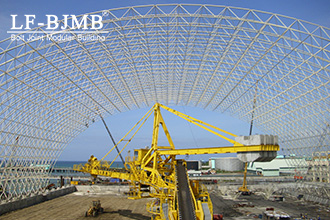
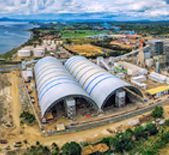
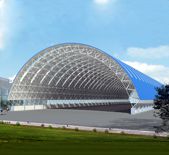
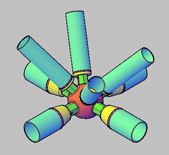
At this juncture, a novel architectural structure—the space structure—emerges, offering new possibilities for constructing large-span buildings. Space structures consist of multiple members connected through nodes, forming an integrated spatial grid. This unique configuration distributes forces evenly across the entire system, fully leveraging steel’s high strength to effortlessly achieve super-large spans of over 100 meters. This enables exhibition centers to provide expansive display areas and allows airport terminals to feature column-free waiting halls. Simultaneously, the spatial grid structure exhibits excellent ductility and energy dissipation capabilities. During natural disasters like earthquakes, it absorbs energy through minor structural deformations, significantly enhancing seismic resistance and ensuring the building’s safety and durability.
Spatial structures offer substantial advantages in construction methodology. Components can be prefabricated in factories using advanced processing equipment and stringent quality control to ensure precision. Transported to the construction site, they are rapidly assembled using prefabricated construction methods, substantially reducing on-site construction time and labor costs. Compared to traditional construction methods, spatial structures can shorten the construction cycle by 30% to 50%, while also minimizing wet operations and construction waste on-site, making them a greener and more environmentally friendly option.
With its distinct advantages in achieving large spans, structural performance, construction efficiency, and environmental sustainability, space structures are becoming the undisputed solution of choice for large-span architecture. As technology continues to advance and innovate, spatial structures will undoubtedly play an increasingly vital role in future large-span construction projects, continuously propelling the building industry toward new heights.


