





 About Us
 2025-09-15
1.Bolt Ball Machining Methods and Key Technical Points
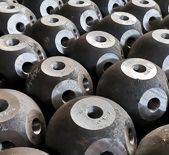
The fabrication of bolt sphere nodes requires adherence to stringent process flows and precision standards. The core workflow encompasses four major stages: raw material selection, forging, reference hole machining, and threaded hole machining. First, premium steel grades are selected, with chemical analysis ensuring material composition compliance. Subsequently, heating is applied for hot forging, with a final forging temperature not below 800°C to prevent cracking and overburning. The formed blank spheres undergo grinding to eliminate wrinkles, followed by hole machining using specialized lathes or CNC machining centers.
Thread machining is the critical stage for precision control, requiring a 6H tolerance standard. Each tap is used no more than 200 times to ensure thread quality. Final inspection covers spatial angle deviation (±10′), distance tolerance from thread hole face to ball center (±0.2mm), and tensile strength testing. For instance, the Zhengzhou Bibo Garden project reduced member internal forces by 20% through optimized thread tolerances and machining processes.
2.Advantages and Features of Bolted-Ball Joints
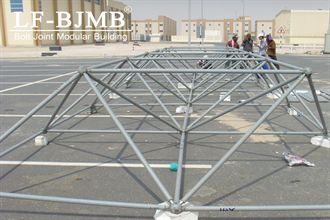
Compared to traditional welded joints, bolted spherical joints offer four core advantages: factory production, efficient installation, controllable precision, and reusability:
(1) Factory Production: Components are mass-produced by specialized manufacturers, ensuring consistent quality and compliance with JG/T 10-2009 standards.
(2) Enhanced Installation Efficiency: On-site work involves only bolt tightening without welding. The Xiamen Taikoo Hangar project reduced construction time by 30% through ball joint application.
(3) Superior Precision Control: Field measurements at a Jinan project showed vertical errors of millimeter-level accuracy for ball joints, compared to centimeter-level errors for welded joints.
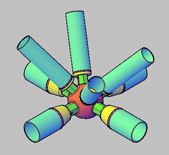
(4) Environmental Adaptability: Hot-dip galvanized or coated with anti-corrosion treatments, these components withstand harsh conditions like humidity and acid rain. Additionally, their load transfer paths are clearly defined—tensile forces are transmitted via bolts, while compressive forces are handled by sleeves—eliminating eccentric loading issues.
3.Representative Project Applications
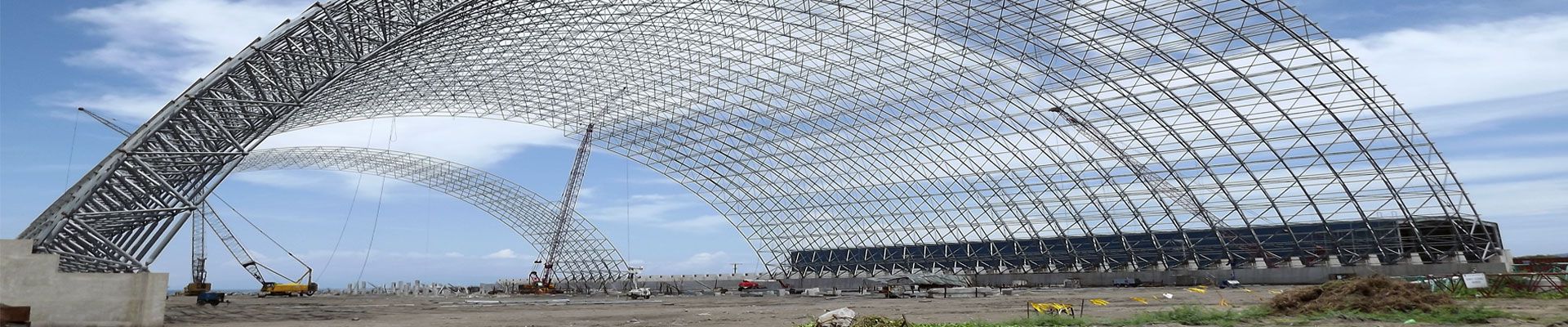
China has achieved globally leading application scale in bolted sphere space frames, with notable examples including:
(1) Large-Span Public Buildings: The Capital Gymnasium (80m span) and Shanghai Stadium utilize double-layer trusses to achieve column-free expansive spaces.
(2) Industrial Facilities: The 60m-span workshop at Shanghai Jiangnan Shipyard and the four-bay hangar at Beijing Capital Airport (84m×150m triple-layer truss) demonstrate exceptional load-bearing capacity.
(3) Innovative Technology Integration: The Chongqing Zoomlion project incorporated BIM technology for 3D modeling, achieving precise installation of a 204m span through the overall jacking construction method.
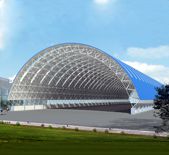
(4) Extreme Environment Applications: The coal yard at Xinjiang Tianfu West Thermal Power Plant employs a double-layer cylindrical dome truss with 220mm diameter bolted spheres, demonstrating stable performance in wind and sand conditions.
4.Installation Methods and Key Technologies
Bolted spherical grid installation follows a five-step process: foundation acceptance → surveying and layout → sectional hoisting → bolt tightening → deformation monitoring:
(1) Foundation Preparation: Flatness tolerance must be <3mm, with elevation deviation controlled within ±2mm.
(2) Spatial Positioning: Total stations determine sphere node coordinates; the Xiamen Hangar project achieved millimeter-level positioning via laser scanning.
(3) Section-by-Section Lifting: Divide the truss into strip-shaped units and install them step-by-step using truck cranes. The Beijing Capital Airport project employed a 500-ton crane to lift an 84m-span unit.
(4) Bolt Tightening: High-strength bolts (e.g., 40Cr 10.9S grade) must be tightened symmetrically in two stages, with torque deviation not exceeding ±5%.
(5) Quality Assurance: Post-installation deflection testing (within L/250) and bolt retightening are required. Gaps are sealed with sealant to prevent corrosion.
For project design or renovation assistance, contact LF for a complimentary assessment and complimentary case study handbook.


