




 About Us
 2026-04-20
Abidjan, the economic capital of Ivory Coast in West Africa, has a tropical maritime climate. The city and its suburbs boast pleasant scenery, featuring roads built with Chinese aid and buildings constructed with assistance from various countries.
The stadium featured today is a 60,000-seat Class A stadium with a total floor area of 61,250 square meters. It includes an international-standard soccer field and rugby field, an athletics track comprising eight curved lanes and ten straight lanes alongside the grandstand, as well as other functional facilities. It is the largest, highest-standard, and most modern stadium in West Africa.
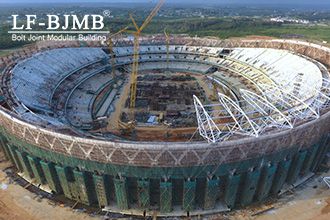
The stadium canopy employs a multi-bay cantilevered inverted triangular steel truss system, which meets the architectural design requirements. Three-dimensional and planar trusses are arranged at the inner ends and along the central circumference to ensure the overall stability of the cantilevered trusses, thereby forming a cohesive structural system. The construction process spanned both the rainy and dry seasons, and the stadium has finally risen from the ground to stand tall on the plain.
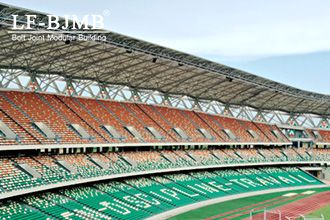
Although Class G membrane material was initially proposed in the design documents, after careful consideration during construction, the material for the membrane canopy was changed to Class P membrane material. The technical performance of the two membrane materials is comparable, and each has its own characteristics. Class G membrane material offers excellent light transmission and self-cleaning properties, which are the primary reasons for its widespread adoption both domestically and internationally. Bend resistance is not a critical factor once the canopy tensioning is complete. However, the transportation limitations of Class G membrane materials were only identified after consulting the Membrane Structure Technical Guidelines. Since building materials must be processed and transported via land and sea, materials that are not resistant to bending may suffer high breakage rates during transit. Even if successfully delivered to the site, given the large size of the membrane panels, any damage caused by wind during installation or tensioning would be nearly impossible to compensate for. In terms of material cost alone, Type P membrane materials are slightly less expensive than Type G membrane materials. Following a review, the design, construction, and client teams all agreed to switch the canopy membrane material to Type P. During on-site construction, the tensioning was completed in a single operation.


