





 About Us
 2026-01-21
Beyond the common approach of adding cables between geodesic dome supports, the canopy added to the courtyard of Hamburg’s Historical Museum employs a radial cable system. Below the horizontal plane, two cables are anchored at one end to the lower supports, while the other ends pull the cluster of cables radiating upward from the central node. The entire cable system is tensioned by tightening these two cables beneath the horizontal plane. tween shell supports, the canopy added to the courtyard of Hamburg’s Historical Museum employs a radial cable system. Below the horizontal plane, two cables are anchored at one end to the lower supports, while the other ends secure the cluster of cables radiating upward from the central node. The entire cable system is tensioned by tightening these two cables beneath the horizontal plane. This design not only enhances the stability of the single-layer shell as stiffening ribs but also directly counterbalances upward wind suction forces. Consequently, the structural members of the single-layer shell for the glass roof can be exceptionally slender.
A similar approach was applied to the skylight of Guangzhou South Railway Station in China, substituting lighter ETFE cushions and PTFE membranes for glass.
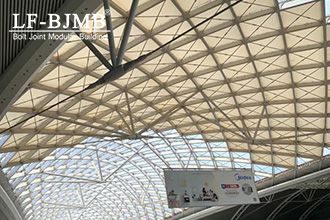
Guangzhou South Railway Station
The skylight serves as an absolute architectural highlight; visitors entering the atrium instinctively look up to admire it.
The structural logic of free-form glass skylights is nearly universal—whether a single-layer shell with a triangular grid or a quadrilateral grid with diagonal cables, the underlying form is essentially triangular. A triangle lies in a single plane, whereas the corners of a spatial quadrilateral are often non-coplanar. Thus, triangular glass panels can be planar, and any complex curved surface can be discretized into triangular grid units. Simultaneously, triangular grids are structurally stable, whereas quadrilateral planes exhibit poor stiffness and are prone to deformation. Employing a triangular grid allows for slenderer member cross-sections.
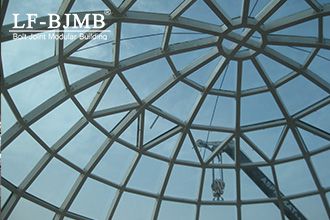
For smaller-span, regular spherical or cylindrical skylights, quadrilateral meshes create a clean, uncluttered appearance. Take our LF Togo Presidential Palace hemispherical skylight: the glass is directly bonded to the square steel tube members of the shell structure without additional aluminum framing, resulting in a remarkably streamlined look.
The Milan Exhibition Center’s ground-level skylight employs triangular meshes in complex geometric and load-bearing areas, while quadrilateral meshes are used along the roof edges where bending forces dominate. This approach balances structural integrity with visual simplicity.
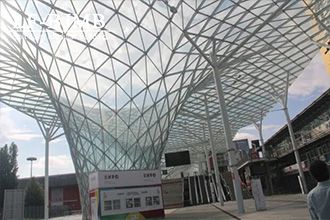
Milan Exhibition Center
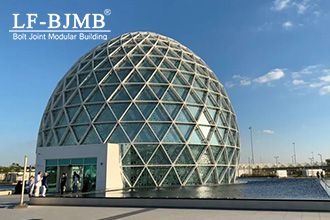
The dome over the visitor entrance hall at the Abu Dhabi Mosque exposes its interlocking square grid shell structure externally, creating a distinctive aesthetic.
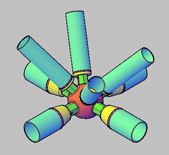
Skylight structural design prioritizes safety while pursuing lightness, simplicity, and visual appeal. Consequently, single-layer grid shells with rigid joints are highly favored. Intersecting joints, welded sphere joints, and cast steel joints all meet rigid joint requirements.
LF specializes in lightweight, structurally refined components and recyclable materials, emphasizing installation flexibility and low-maintenance surface treatments to ensure product longevity, high quality, functionality, and aesthetic appeal. For inquiries regarding glass domes or other matters, please feel free to contact us at any time.


